
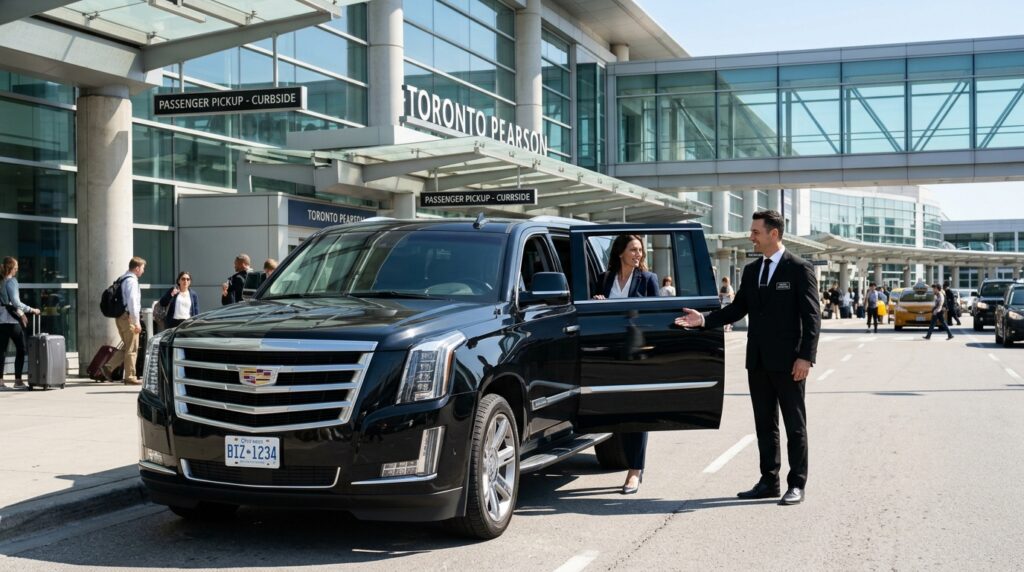
Arriving at Toronto Pearson International Airport (YYZ) presents travelers with an immediate financial and logistical question: how should you get to your final destination, and which option delivers the best combination of price transparency, safety, and reliability?
Direct Answer: Is a Flat-Rate Airport Limo Cheaper Than Uber Black or Metered Taxis in Toronto?
Yes, in high-traffic, bad weather, or peak arrival conditions, a pre-arranged flat-rate airport limo is frequently cheaper and significantly more predictable than Uber Black or metered taxis. While municipal taxis charge by an elapsed-time mechanical meter that spikes during Highway 401 or Gardiner Expressway gridlock, and Uber Black enforces dynamic surge pricing (often 1.5x to 2.5x base fare), a pre-arranged luxury black car guarantees a locked-in flat rate by geographic zone. Additionally, airport limos include commercial livery licensing, professional chauffeurs, flight tracking, and curbside compound dispatch without surge pricing volatility.
Whether you are a visiting corporate executive, a vacationing family with five suitcases, or a frequent flyer returning home to Oakville or Markham, understanding the regulatory and pricing architecture of Pearson Airport ground transit saves you hundreds of dollars and unnecessary travel headaches.
Table of Contents
- The 4 Categories of Pearson Airport Ground Transportation
- How GTAA Regulated Flat-Rate Tariffs Work
- Detailed GTA Tariff Zones Breakdown (Toronto, Peel, York, Halton)
- The Mechanical Meter Trap: Why Toronto Taxis Get Expensive in Traffic
- The Algorithmic Pitfalls of Uber Black and Rideshares at Pearson
- Comprehensive 2026 GTA Pricing Comparison Matrix
- Highway 407 ETR Tolls: When Is the Toll Bypass Worth It?
- Vehicle Standards, Commercial Insurance & Chauffeur Vetting
- Luggage Capacities & The Economic Math of Executive SUVs
- 5 Hidden Fees to Watch Out For When Leaving Pearson Airport
- How to Audit Your Airport Ground Transportation Receipt
- Frequently Asked Questions (FAQ)
The 4 Categories of Pearson Airport Ground Transportation
When stepping out of Terminal 1 or Terminal 3 into the arrivals roadway, passengers encounter four distinct ground transit models, each governed by different licensing rules and fee structures:
- Pre-Arranged Luxury Black Cars & Limousines (e.g., Pearson Black Car):
Private luxury sedans and executive SUVs booked prior to arrival. These vehicles are regulated under the Greater Toronto Airports Authority (GTAA) Pre-Arranged Ground Transportation operating bylaws. Chauffeurs stage off-terminal and pull up directly to designated doors upon passenger check-in (see our step-by-step guide on how to find pre-arranged limos at Door R and Door G) at guaranteed, pre-negotiated flat rates.
- On-Demand Airport Taxis & Limos (Curbside Lineup):
Official GTAA licensed airport taxis and sedans waiting in the physical curbside queue directly outside the terminals. No advance reservation is needed, but passengers must wait in public lines and accept whatever vehicle is next in the rotation.
- Transportation Network Companies (TNCs: Uber & Lyft):
App-based gig drivers using personal or commercial vehicles. Pickups are restricted to designated, distant passenger loading zones, subject to algorithmic supply/demand surge multipliers, airport pickup surcharges, and variable vehicle conditions.
- Unlicensed “Gypsy” Cabs (Strict Warning):
Illegal operators loitering inside baggage claim soliciting arriving passengers. These drivers lack GTAA commercial permits, possess standard personal auto insurance that is completely void during commercial transport, and routinely charge exorbitant, arbitrary fees.
How GTAA Regulated Flat-Rate Tariffs Work
The GTAA establishes official geographic zone tariffs for airport trips leaving Pearson. The Southern Ontario region is divided into mapped zones based on distance from YYZ.
When you book with a premier flat-rate car service like Pearson Black Car, the fare is predetermined strictly by your destination municipality and postal code. Key structural benefits of the flat-rate tariff system include:
- Traffic Immunity: If the Gardiner Expressway or Don Valley Parkway (DVP) is at a complete standstill due to ongoing construction or a multi-vehicle accident, your price does not climb a single cent.
- Weather Price Protection: During heavy Canadian winter snowstorms, when travel times may double, flat-rate fares remain completely locked.
- Transparent Corporate Expense Accounting: Business travel coordinators can budget transportation expenses with 100% accuracy (learn more about our corporate car service billing and monthly invoicing), knowing the exact billing amount before the traveler even departs.
Detailed GTA Tariff Zones Breakdown (Toronto, Peel, York, Halton)
The Greater Toronto Area is divided into specific municipal boundaries under commercial airport licensing regulations. Understanding how your destination is zoned clarifies how flat rates are constructed:
1. City of Toronto Zones
The City of Toronto is subdivided into multiple distinct airport tariff grids based on major longitudinal and latitudinal corridors:
- Zone 1 (Downtown Financial District / Waterfront): South of Bloor Street, bounded by the Don Valley Parkway to the east and Bathurst Street to the west. This is the primary corporate corridor.
- Zone 2 (Midtown & Yorkville): Bounded by Bloor Street to Eglinton Avenue, spanning Yonge Street, Avenue Road, and Mount Pleasant.
- Zone 3 (North York & Uptown): North of Lawrence Avenue up to Steeles Avenue, encompassing the Highway 401 corridor, Willowdale, and Don Mills.
- Zone 4 (Scarborough & East End): East of Victoria Park Avenue toward Pickering. Because distance exceeds 40 km, flat rates ensure predictable travel costs compared to soaring taximeters.
- Zone 5 (Etobicoke): Directly adjacent to Pearson Airport, providing rapid 10-to-15 minute transit times to major business parks and residential neighborhoods.
2. Regional Municipality of Peel (Mississauga & Brampton)
Because Pearson Airport is located inside the municipal limits of Mississauga, travel times into Peel Region are the shortest across the GTA:
- Mississauga City Centre / Hurontario: High density corporate travel corridor, 15 to 20 minutes from terminal curbs.
- Brampton West & Downtown Brampton: Rapid access via Highway 410 and Highway 407 ETR.
3. Regional Municipality of Halton (Oakville & Burlington)
Located southwest along Lake Ontario, Halton Region represents one of the largest commuter bases for executive business travelers:
- Oakville (Southeast & Lakeshore): Traversed via the QEW and Highway 403. Rush hour congestion often causes metered cabs to spike, making flat rates essential.
- Burlington & Aldershot: Bordering Hamilton, approximately 45 to 55 km from Pearson.
4. Regional Municipality of York (Vaughan, Markham, Richmond Hill)
Spanning north of Steeles Avenue, York Region is home to Canada’s largest high-tech and corporate office parks:
- Vaughan Metropolitan Centre (VMC): 15 to 25 minutes via Highway 407 or Highway 427 North.
- Markham Innovation Corridor: Home to IBM, AMD, and major multinational campuses, frequently accessed via Highway 407 ETR.
The Mechanical Meter Trap: Why Toronto Taxis Get Expensive in Traffic
Standard municipal street taxis calculate fares through a physical taximeter combining two factors:
- Distance Traveled: Calculated in 140-meter increments once the initial drop flag fee is applied.
- Elapsed Time (Waiting Time): Whenever the taxi is moving under 15 km/h or idling in traffic, the meter automatically switches from distance tracking to an hourly waiting charge (typically $30.00 to $45.00+ per hour).
On an open highway at 11:00 PM, a metered cab to downtown Toronto might read $65.00. However, during weekday afternoon rush hour (3:30 PM to 7:00 PM), when Highway 427 and the Gardiner Expressway grind to a crawl, the idling meter continues ticking rapidly. That identical journey easily escalates to $95.00 to $120.00+, turning an ordinary ride into a budget-busting surprise.
The Algorithmic Pitfalls of Uber Black and Rideshares at Pearson
While rideshare apps are popular for short city errands, their dynamic algorithmic pricing creates severe volatility at Pearson Airport:
1. Peak Surge Multipliers
When multiple transatlantic or transborder flights touch down within 20 minutes (common between 3:00 PM and 7:00 PM), thousands of passengers open rideshare apps simultaneously in the baggage claim area. The demand algorithm immediately triggers surge pricing. A trip that normally displays at $85.00 can instantly spike to $140.00 to $210.00 for an Uber Black or UberXL.
2. The Remote Pickup Trek
Unlike pre-arranged airport limousines that pull right up to the commercial terminal curb (Door R / Door G), rideshare passengers must follow extensive signage across footbridges or into separate parking garage levels carrying heavy luggage. In freezing Canadian winter weather, this trek is particularly unwelcoming.
3. Driver Cancellations & Vehicle Quality Roulette
Even when paying top dollar for Uber Black or UberXL, passengers frequently experience cancellations when drivers realize their destination has heavy return traffic. Furthermore, vehicle cleanliness and driver professionalism can vary widely, whereas an executive luxury car fleet guarantees meticulous vehicle standards and suited chauffeurs.
Comprehensive 2026 GTA Pricing Comparison Matrix
Below is an objective comparison of typical ground transit costs from Toronto Pearson Airport (YYZ) across major GTA and Golden Horseshoe destination hubs:
| Destination Region | Pearson Black Car (Guaranteed Flat Rate) | Metered City Taxi (In Rush Hour Traffic) | Uber Black (With Rush Hour Surge) |
|---|---|---|---|
| Downtown Toronto (Financial District / Waterfront) | Guaranteed Fixed Zone Rate | $85 – $115+ (Idling meter volatility) | $120 – $185+ (Algorithmic peak surge) |
| Mississauga (City Centre / Meadowvale) | Guaranteed Fixed Zone Rate | $45 – $70+ (Traffic delays on 401/403) | $65 – $110+ (Surge during flight arrival waves) |
| Oakville & Burlington | Guaranteed Fixed Zone Rate | $110 – $145+ (Severe QEW rush congestion) | $135 – $210+ (Suburban driver return surcharge) |
| Markham & Richmond Hill | Guaranteed Fixed Zone Rate | $95 – $130+ (Hwy 401 / 404 slow-downs) | $125 – $190+ (Dynamic surge during rush) |
| Intercity Travel (Niagara / Waterloo / London) | Dedicated intercity flat rate (explore our complete guide to outside GTA transfers) | Often refused by drivers; astronomical meter | Rideshare drivers cancel 100+ km trips |
For more details on city transit choices, read our complete Toronto Pearson to downtown transportation guide.
Highway 407 ETR Tolls: When Is the Toll Bypass Worth It?
Highway 407 ETR is an all-electronic, privately operated toll expressway that spans across the northern top of the GTA from Burlington to Pickering. For travelers heading to Vaughan, Markham, Richmond Hill, or Brampton during afternoon rush hour, the 407 represents a critical time-saving bypass:
- Bypassing Highway 401 Bottlenecks: While Highway 401 through Toronto is recognized as the busiest highway corridor in North America, Highway 407 moves at free-flowing highway speeds even at 5:15 PM. Taking the 407 routinely cuts 30 to 45 minutes off travel times.
- How Tolls Are Billed: With municipal street taxis, drivers pass along camera charges, trip fees, and per-km rates, often creating unpredictable bill spikes. Pearson Black Car clarifies 407 toll options transparently prior to dispatch.
Vehicle Standards, Commercial Insurance & Chauffeur Vetting
The differences between transit models extend beyond the dollar amount on the receipt:
- Commercial Liability Coverage: Pearson Black Car operates under commercial livery insurance policies with comprehensive liability limits. In contrast, gig-economy rideshares rely on hybrid contingent policies that have strict coverage boundaries depending on the app’s connection status.
- Background Vetting & Chauffeur Etiquette: Our executive chauffeurs undergo background checks, defensive driving certifications, and training in executive etiquette, discretion, and luggage handling.
- Cabin Comfort: Vehicles are equipped with bottled water, device charging ports, tinted privacy glass, and spotless leather seating—functioning as a mobile office for busy travelers.
Luggage Capacities & The Economic Math of Executive SUVs
A common scenario for traveling families and executive delegations is carrying 4 to 6 large checked suitcases plus carry-on bags. A standard sedan or compact rideshare vehicle cannot accommodate this volume of luggage.
When traveling in groups:
- The Two-Rideshare Dilemma: If a family hails rideshares, they are forced to book two separate vehicles, doubling their travel cost and dividing their party.
- The Executive SUV Solution: Booking a luxury full-size SUV (such as a Cadillac Escalade or Chevrolet Suburban) accommodates up to 6 passengers and 6 large suitcases in a single vehicle. The flat rate of one premium SUV is often 30% to 50% cheaper than paying for two separate surge-priced rideshares.
5 Hidden Fees to Watch Out For When Leaving Pearson Airport
To review exact route estimates, read our guide on black car costs from Pearson. Before selecting your ride, check for these hidden surcharges that commonly inflate final transportation costs:
- Airport Ingress/Egress Surcharges: Rideshares and taxis pass GTAA airport access fees onto passengers, appearing as unexpected line items on the final receipt.
- Highway 407 ETR Electronic Toll Charges: Taking Highway 407 ETR can bypass Highway 401 gridlock, but taxi meters and rideshares add video tolls and transponder surcharges. Pearson Black Car clarifies 407 options upfront during booking.
- Waiting Time & Flight Delay Charges: If baggage takes 60 minutes to reach the carousel, metered taxis or rideshare drivers will cancel or charge per-minute waiting fees. Pearson Black Car includes generous complimentary grace periods (45 mins domestic, 60–75 mins international).
- Credit Card Transaction Fees: Some municipal cabs add extra processing fees for credit card payments. Pre-arranged services provide transparent, all-inclusive receipts.
- Child Seat Surcharges: Standard taxis do not supply child car seats, forcing parents to risk safety or carry bulky equipment. Pearson Black Car offers pre-installed child seats upon advance request. Learn more about our car service with child seats at Pearson and review our complete guide on Ontario airport child car seat laws.
How to Audit Your Airport Ground Transportation Receipt
If you travel for business and submit expense claims to corporate finance or corporate accounting software (like SAP Concur or Expensify), keeping receipts audit-proof is critical:
- Verify HST Registration Numbers: In Ontario, commercial transportation is subject to 13% Harmonized Sales Tax (HST). Legitimate receipts must feature an official CRA Business Number (e.g., 123456789 RT0001) so your organization can claim Input Tax Credits (ITCs).
- Check for Base Fare vs. Surcharge Separation: Ensure fuel surcharges, tolls, and airport pickup fees are transparently itemized rather than lumped into an unexplained total.
- Ensure Route Tracking & Timestamps: A compliant invoice clearly lists flight numbers, terminal doors, and exact arrival timestamps. Pearson Black Car issues automated, itemized PDF receipts directly upon journey completion.
Frequently Asked Questions (FAQ)
Is a flat-rate airport limo cheaper than an Uber in Toronto?
During peak travel hours, rush hour gridlock, winter snowstorms, or high-volume flight arrival windows, a flat-rate airport limo is often cheaper than Uber Black or UberXL. Rideshare surge multipliers frequently drive fares well above fixed flat rates, whereas a pre-arranged black car locks in your price regardless of highway traffic.
How are flat rates determined from Toronto Pearson Airport?
Flat rates from Pearson Airport are structured based on established GTAA geographic tariff zones covering the Greater Toronto Area and Southern Ontario. Fares are determined by destination municipality and postal code, ensuring the passenger knows the exact cost prior to departure.
Can I get a flat rate if I hail a taxi at the terminal curb?
Official GTAA taxis at the terminal curbside line offer zone flat rates or metered fares depending on the destination. However, you must wait in the public queue, cannot select your vehicle make, and do not receive flight monitoring or personalized chauffeur greeting.
What door do I go to for pre-arranged black cars at Pearson?
At Terminal 1, go to Door R on the Ground Level (Arrivals). At Terminal 3, go to Door G on the Arrivals Level. Approach the commissionaire desk, provide your name and specify Pearson Black Car, and your vehicle will pull up within 3 to 5 minutes.
Are airport limos insured for corporate and commercial travel?
Yes. All vehicles in Pearson Black Car’s executive fleet carry commercial livery passenger insurance and undergo rigorous safety inspections required under GTAA and Ontario Ministry of Transportation regulations.
Experience Transparent, Flat-Rate Luxury Ground Transportation
Avoid the unpredictability of mechanical taximeters and surge-pricing algorithms. Book your seamless, fixed-rate airport transfer with Toronto’s trusted executive black car service.
Traveling with executive clients or have complex multi-stop itineraries? Contact our concierge desk.